
Symmetry is one of the clearest ways a mandala turns many separate shapes into one connected composition.
A center, repeated forms, mirrored sections, and recurring colors give the eye a structure it can follow across the whole design.

Symmetry turns separate shapes into one composition
A mandala may contain dozens or even hundreds of individual shapes.
What makes them feel connected is the relationship between those shapes.
A curve appears on one side and returns on another.
A petal repeats around the center.
A color introduced in one section reappears somewhere else in the circle.
Symmetry gives the page a visual rule that many different details can share.
The center gives every section a reference point
Most mandala structures are organized around a center.
That center may be a point, a circle, a flower, a symbol, a figure, or a small geometric field.
From there, the rest of the composition can expand outward through rings or repeated sections.
The important relationship is simple:
- the center establishes orientation
- surrounding forms relate back to it
- repetition connects distant sections
- the outer boundary contains the complete composition
The center gives the rest of the structure somewhere to belong.
Radial symmetry creates movement around the circle
Radial symmetry repeats forms around a central point.
Imagine one shape placed at the top of a circle.
Rotate it a little and repeat it.
Continue the same movement around the center and a new circular structure begins to appear.
The repeated form may be a triangle, petal, line, symbol, or animal silhouette.
The individual shape stays recognizable, but repetition gives it a second identity as part of the larger mandala.
Mirror symmetry connects opposite sections
Not every mandala relies only on rotation.
Some designs also use mirrored relationships.
A shape on the left may answer a shape on the right.
A curve above the center may return below it.
These mirrored sections create visible pairs across the composition.
That becomes especially interesting while coloring because the same decision can be repeated exactly, slightly changed, or deliberately broken on the opposite side.
Repetition creates the visual rhythm
Symmetry becomes easier to see when a form repeats.
One petal is simply a petal.
Eight petals arranged around a center become a circular rhythm.
One animal silhouette is an animal.
Several silhouettes rotated around the same center can become the structure of an animal mandala.
Repetition changes how we read the form.
We begin to see both the individual element and the pattern it creates with the others.
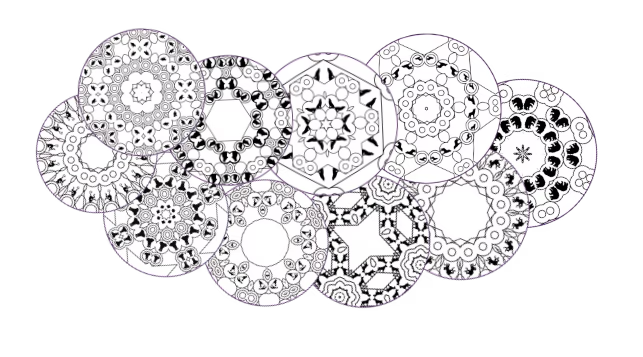
This becomes especially clear in Round shaped animal mandalas, where the animal itself can become the repeating form.
Color can reveal symmetry even more clearly
A black-and-white mandala already contains structural relationships.
Color can make those relationships much easier to see.
If the same color appears in every repeated section, the symmetry becomes immediately visible.
If two colors alternate around the circle, a second rhythm appears.
If each ring uses a different palette, the layers become easier to separate.
Color can therefore work in several ways:
- repeat the symmetry
- divide the design into rings
- connect opposite sections
- create alternating sequences
- highlight one structural layer over another
The outlines create the structure. Color can show us how that structure is organized.
Symmetry appears in nature in many different ways
Nature gives us many examples of repeated and balanced forms.
- Butterfly wings show bilateral symmetry
- Many flowers arrange petals around a center
- Snowflakes develop through repeated sixfold structures
- Starfish often organize body parts radially
- Leaves can show mirrored relationships around a central vein
Not every natural form is perfectly symmetrical.
That is part of what makes these examples interesting.
The underlying structure may be balanced while individual details remain irregular.
Symmetry can provide the framework while variation keeps the form alive.
Different traditions use symmetry in different ways
Symmetry also appears in many historical visual traditions.
A Sri Yantra builds complexity through interlocking triangles.
A Tibetan mandala may combine a central square, gates, circles, figures, and repeated directional sections.
Islamic geometry can extend repeated stars and polygons beyond a single center.
A Gothic rose window divides a circle into radial sections of stone and colored glass.
The structures are different, but each shows how repetition and geometry can organize a large visual field.

See these forms side by side in the history of mandalas across cultures and traditions.
Symmetry and irregular patterns create different visual experiences
A symmetrical design gives us repeated relationships to recognize.
An irregular design can avoid those repetitions and let each area develop independently.
Neither approach is automatically better.
They simply organize the page differently.
- Symmetry connects distant sections through repetition
- Irregular patterning allows each section to develop more independently
- Symmetry can make recurring color choices easy to see
- Irregularity can create more variation from one area to another

The difference becomes especially visible in animal mandalas vs zentangles.
Symmetry gives coloring choices somewhere to repeat
One of the practical pleasures of coloring a symmetrical design is that a decision can travel through the page.
Choose a color for one shape.
Then find the same shape again.
Repeat the color and a relationship appears.
Change it and a variation appears.
A palette can therefore grow through the structure rather than being planned completely in advance.
One small choice can become part of the whole composition simply by repeating it.

You can explore this directly with the free 4-week AnimalMandala experience, where one design changes through different seasonal color directions.
Why symmetry matters so much to AnimalMandala
AnimalMandala began with a simple question:
What if the animal itself became part of the symmetry?
Instead of filling a single animal silhouette with tiny decorative patterns, the silhouette can be repeated, rotated, mirrored, and balanced around a center.
The animal remains recognizable.
At the same time, its repeated form helps build the larger circular composition.
That is the central visual idea behind the project:
The animal becomes the mandala.
Continue with What are animal mandalas? to explore that idea in more detail.
A simple way to explore symmetry through color
- Find the center of the design
- Identify one repeated shape
- Follow where that shape appears around the circle
- Choose one color and repeat it across matching sections
- Introduce a second color and watch how the visual rhythm changes
The more we look for repeated relationships, the more of the mandala structure becomes visible.
Symmetry is something we can actively discover while coloring it.