
The history of mandalas begins most clearly in South Asian religious traditions, but the visual language of the circle appears far beyond them.
Across time and place, people have organized images around centers, repeated forms, divided space into sections, and used color to make structure visible.

A circle can organize an entire visual world
A circle gives us a center, an edge, and the space between them.
From that simple structure, a design can grow through rings, spokes, petals, triangles, squares, figures, or repeating geometric units.
Color can divide those areas even further.
One section can answer another. One color can return on the opposite side. A repeated form can travel around the center until the whole image begins to feel connected.
This relationship between center, repetition, sections, and color is one of the most fascinating things to follow across different visual traditions.
For the basic structure first, see What are mandalas?.
Sri Yantra: triangles building a world around a center
The Sri Yantra is one of the clearest examples of how a centered geometric design can become extraordinarily complex without losing its structure.
Nine interlocking triangles generate dozens of smaller triangular spaces.
Around them, lotus forms, circles, and an outer enclosure create additional layers.
The eye can move from the central point outward, crossing one geometric boundary after another.
What begins as a center becomes a system of repeated angles, intersections, rings, and nested sections.
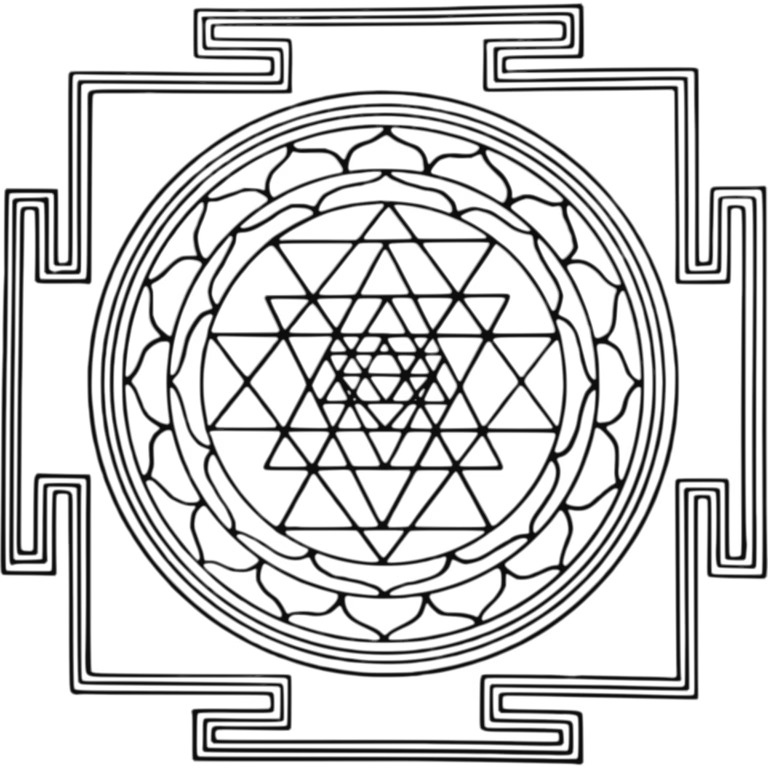
Image source and license: Wikimedia Commons.
Tibetan sand mandalas: a world organized in layers
A Tibetan Buddhist sand mandala makes the relationship between structure and color immediately visible.
The composition begins from a center and expands through clearly separated zones.
Squares, gates, circles, repeated motifs, and directional sections build one layer around another.
Color helps us read those layers.
Reds, blues, greens, yellows, whites, and darker outlines separate one field from the next while repeated details keep the composition connected.
The result is not simply a decorated circle. It is a carefully organized visual environment.
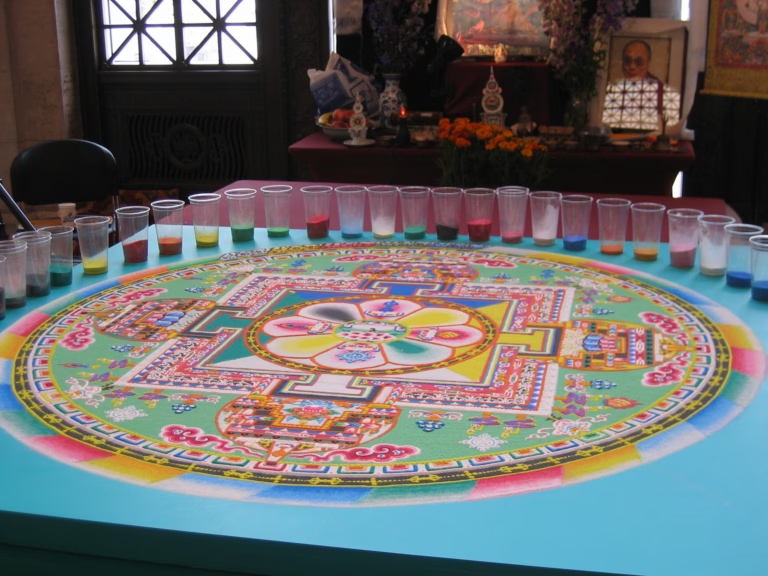
Image source and license: Wikimedia Commons.
The religious context behind these structures is explored further in mandalas in Hinduism and Buddhism.
Medicine Wheel: a circle divided by direction
At the Bighorn Medicine Wheel in Wyoming, the circle is physically marked in stone.
A central cairn becomes the point of reference.
Stone lines extend outward like spokes and connect the center with the perimeter.
Visually, the structure is easy to read: center, circumference, direction, and repeated divisions of space.
The landscape also becomes part of the composition because the wheel is not separated from its location.
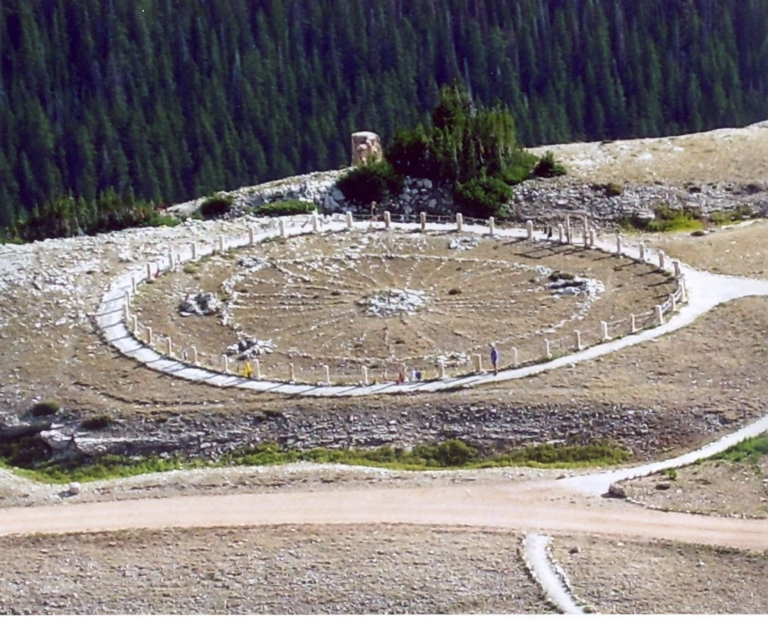
Image source: Wikimedia Commons, public domain.
Its cultural meaning belongs to the Indigenous traditions connected with the site, but its visible organization gives us another way to see how a circle can divide and orient space.
Diné sandpainting: symmetry through figures, directions, and color
Historic photographs of Diné sandpainting show another way of organizing images around balance and repeated relationships.
Figures can appear in reciprocal positions.
Colors return across the composition.
Lines connect groups and directions, while the center helps hold the whole image together.
The result is not based on abstract geometry alone.
Human and symbolic figures become part of the symmetry itself.
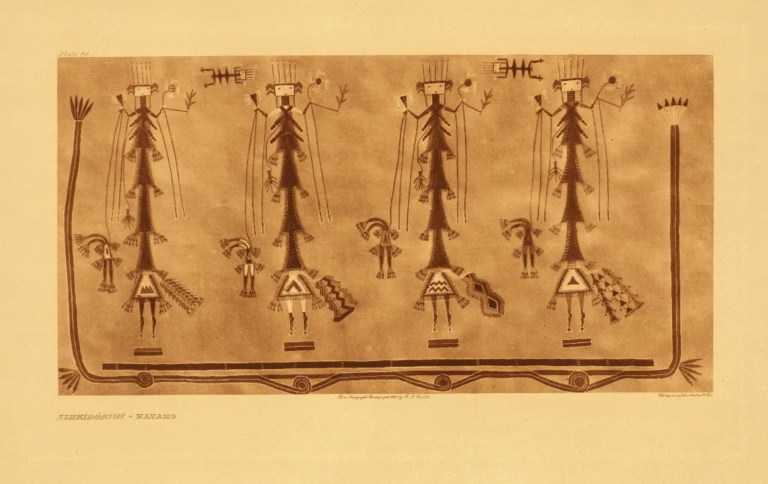
Image source: Wikimedia Commons, public domain.
Here the visual lesson is different again: repetition does not have to mean identical geometric shapes. It can also come from figures, mirrored positions, directional groupings, and repeated colors.
Islamic geometry: repetition that can continue beyond the edge
Islamic geometric design often begins with a small set of shapes and relationships.
Stars connect to polygons.
Polygons generate new stars.
Lines cross, repeat, and extend into a larger field.
Unlike a composition that always pulls us back toward one center, a tessellated pattern can suggest that the geometry continues beyond the visible edge.
Color can reinforce this structure by repeating in alternating stars, borders, polygons, or bands.
One unit becomes many, and the repeated system becomes more important than any single shape.
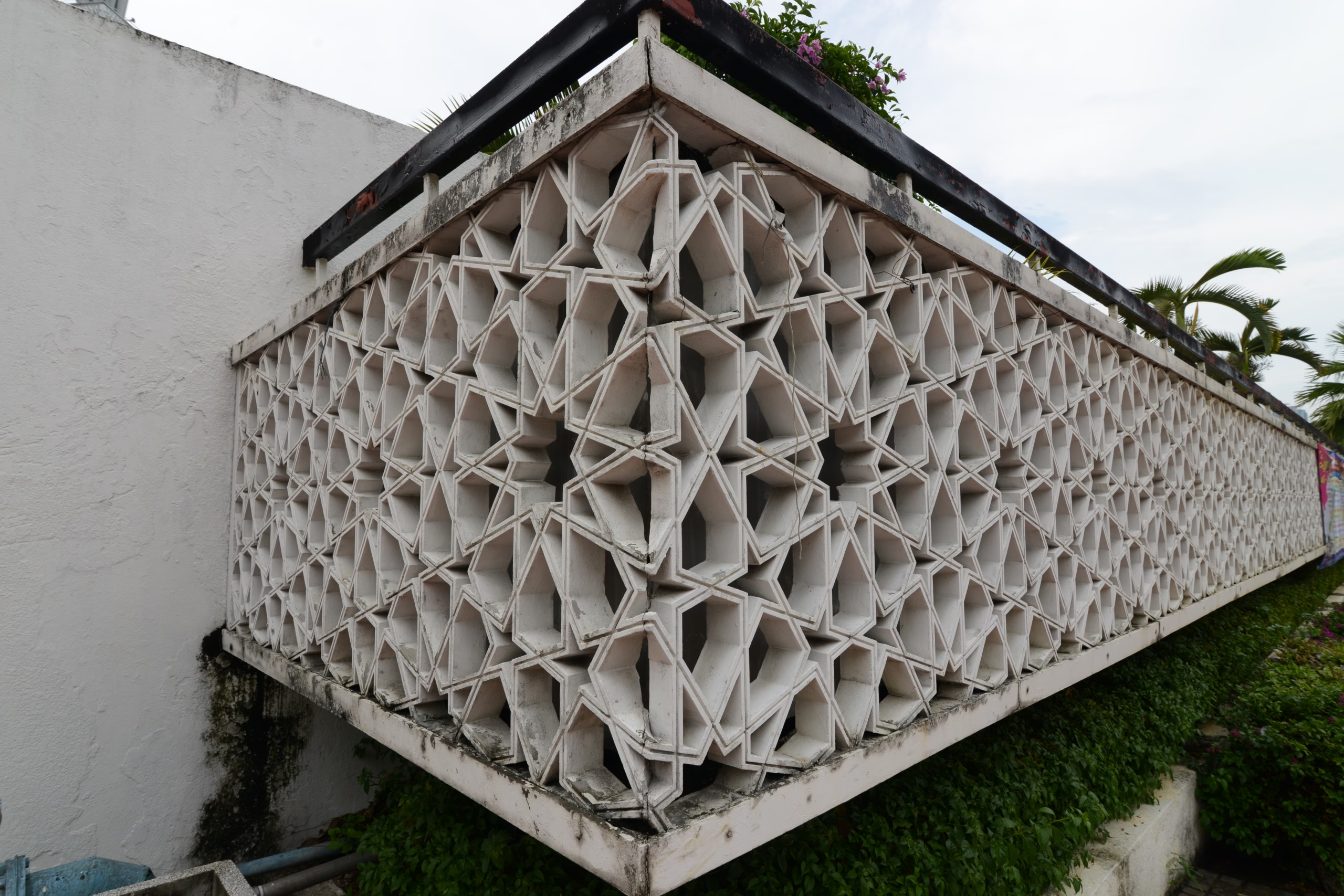
Image source and license: Wikimedia Commons.
Gothic rose windows: color divided into radial sections
A Gothic rose window turns circular structure into architecture, light, and color.
Stone tracery divides the circle into radial sections.
Those sections repeat around the center like petals or spokes.
Stained glass then fills the geometry with separate fields of blue, red, gold, and other colors.
When sunlight passes through the glass, the structural divisions become even more visible.
The circle acts almost like a framework that tells color where to live.
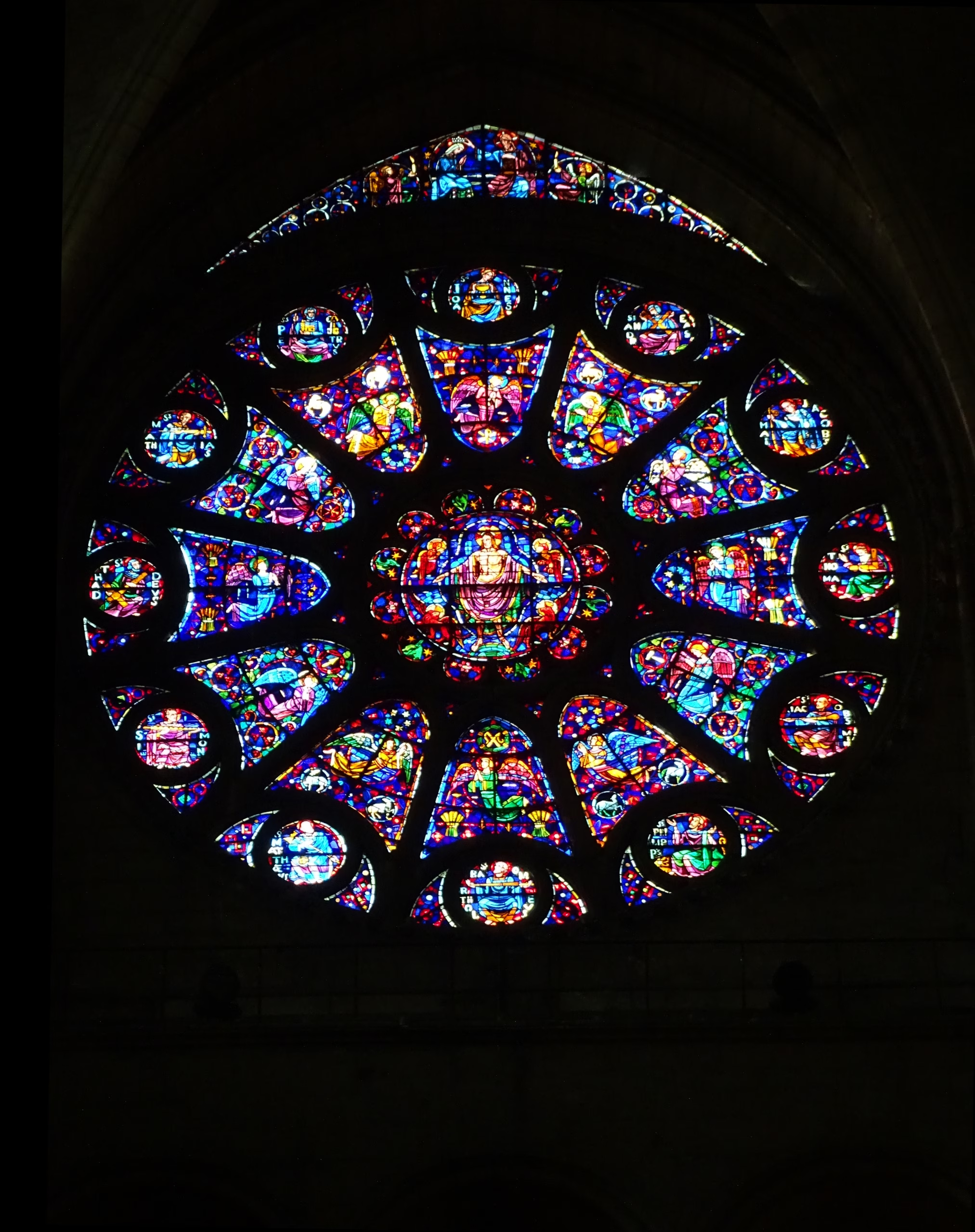
Image source and license: Wikimedia Commons.
What these different forms let us see
Their histories and meanings are different, but placing these images next to one another reveals a fascinating visual vocabulary.
- A center can organize the composition
- A perimeter can contain it
- Spokes, petals, figures, or geometry can divide it into sections
- Repeated forms can connect distant areas
- Symmetry can make relationships visible
- Color can distinguish sections or bind them together
Sometimes the composition expands outward from one center.
Sometimes repetition creates a field that could continue forever.
Sometimes figures carry the symmetry.
Sometimes architecture divides the circle into windows of color.
The same basic tools can produce completely different visual worlds.
From historical circles to modern animal mandalas
Modern animal mandalas add another possibility to this long visual conversation.
Instead of building the repetition only from triangles, petals, stars, or architectural divisions, the repeated form can be an animal.
In AnimalMandala, a silhouette can rotate, mirror, repeat, and balance around the center.
Open areas around it then become sections where color can expand into forests, oceans, skies, seasons, and other nature-inspired worlds.
This time, the repeating form is the animal.
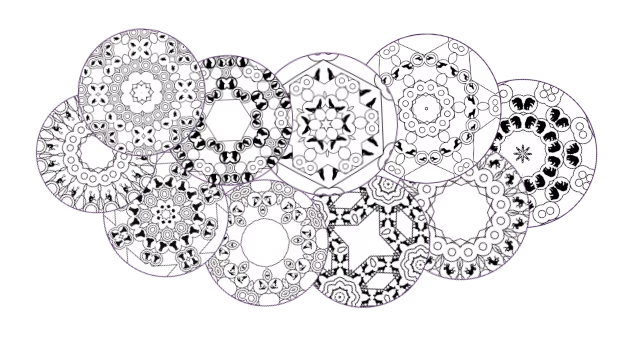
Explore that structure in Round shaped animal mandalas, or begin with What are animal mandalas?.
Look at the circle, then look inside it
A circular image can be simple at first glance.
Then the structure begins to appear.
There is a center. There are divisions. Forms repeat. Colors return. One section connects with another.
And from those few visual ideas, completely different cultures and artists have created remarkably different ways of organizing a world.