
Animal mandalas and zentangle-style animal designs can look related at first glance because both may use repetition, pattern, and detailed line work.
But they organize the page in very different ways.
Animal mandalas are built around a center, circular structure, and repeated relationships, while zentangle-style designs usually build complexity through many smaller patterns inside the form.
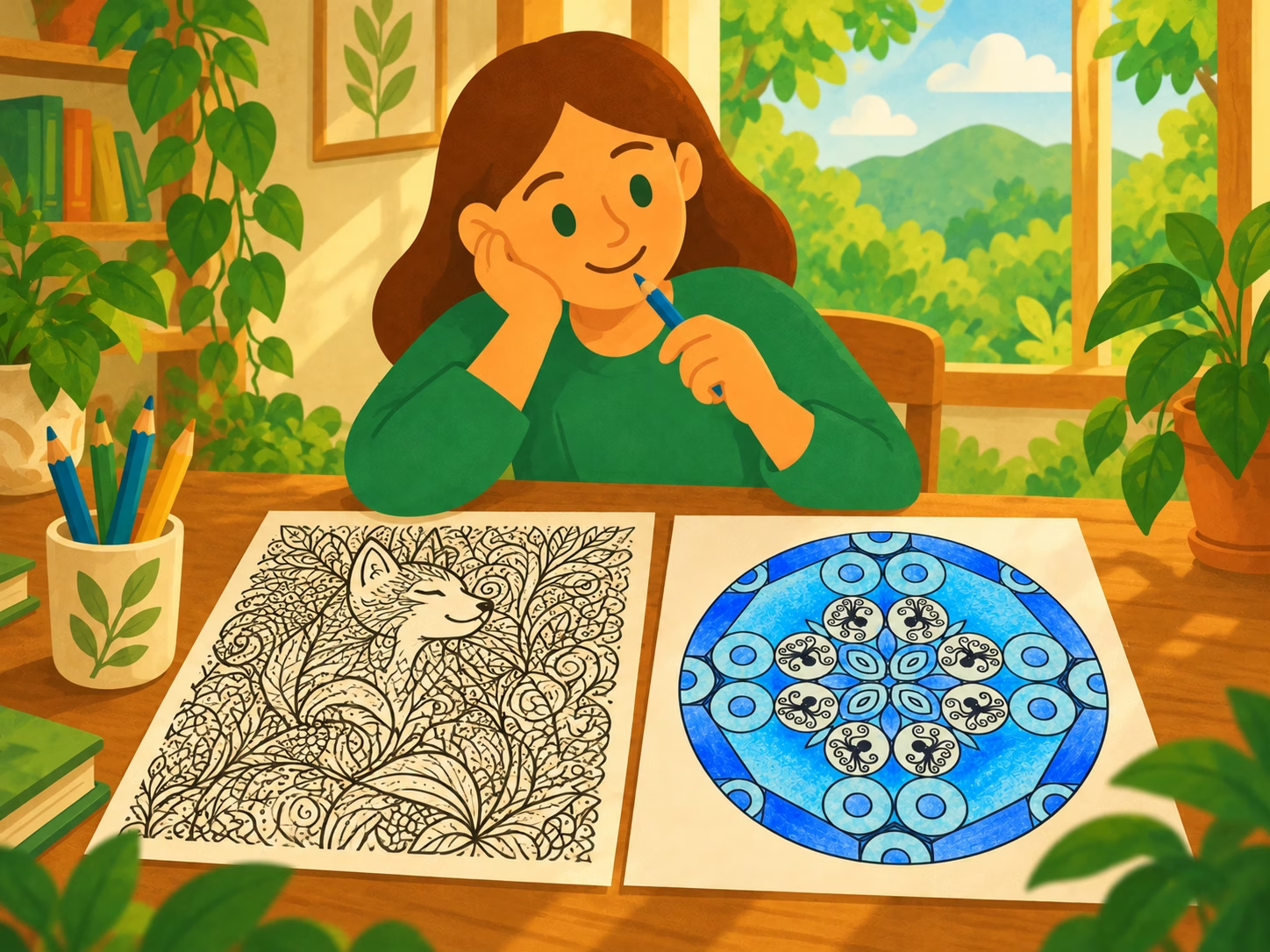
The difference begins with structure
A design can contain an animal, detailed patterns, and geometric decoration without being built as a mandala.
The key difference how the parts relate to the whole.
In a mandala, the composition is usually organized around a center.
Forms repeat, rotate, mirror, or radiate around that point.
In zentangle-style animal designs, the animal often acts as the container while many independent patterns fill the silhouette.
Both approaches can be visually rich.
They simply build that richness in different ways.
What defines a mandala structure
A mandala is built through relationships that repeat across the composition.
- A center gives the design a reference point
- Forms repeat around or across that center
- Sections connect through symmetry or rotation
- Color can repeat across corresponding areas
- The outer shape reads as one complete composition
The important part is that individual elements do not stand alone.
Each section participates in a larger circular system.

This structure is explored more closely in the power of symmetry in mandala design.
How zentangle-style animal designs build complexity
Zentangle-style animal art often begins from a different idea.
The silhouette of the animal remains recognizable, while the interior is divided into smaller zones.
Each zone can contain its own repeated marks:
- lines
- dots
- curves
- scales
- spirals
- grids
- floral or geometric motifs
One area may use one pattern and the next area another.
The patterns can change scale, direction, density, and shape as they move through the animal.
The visual interest comes from variation inside the silhouette rather than from one repeated circular structure around it.
Where the color goes changes too
The structural difference changes the role of color.
In a zentangle-style animal, many of the coloring decisions happen inside the silhouette.
Small internal patterns create many separate areas.
A color may belong to one tiny motif and then disappear completely in the next.
In AnimalMandala, the silhouette can remain visually strong while color expands through larger surrounding sections.
This creates a different set of possibilities:
- larger color fields
- repeated colors across symmetrical sections
- background atmosphere
- nature-inspired palettes
- clearer relationships between distant areas
The difference is where color is allowed to live.
Symmetry lets one choice travel through the page
In a symmetrical animal mandala, one decision can repeat across several sections.
Choose a color for one form.
Find the same form again around the circle.
Repeat the color and a visible relationship appears.
Change it and the symmetry remains, but the palette develops a variation.
In a pattern-filled animal, each internal area may invite a new decision instead.
That creates a more fragmented, highly detailed kind of coloring.
Neither approach is automatically better.
They create different visual rhythms because they distribute repetition differently.
AnimalMandala moves the pattern outside the animal
This is the main creative difference behind AnimalMandala.
Instead of treating the animal as a container for decorative patterns, the silhouette itself becomes part of the repeated structure.
The animal can rotate, mirror, repeat, and balance around a center.
That leaves the surrounding space available for larger fields of color.

The animal is not filled with the mandala. The animal helps build the mandala.
That idea is explored visually in Round shaped animal mandalas.
A side-by-side comparison
- Zentangle-style animal: one animal silhouette containing many smaller patterns
- Animal mandala: animal forms participating in one larger symmetrical composition
- Zentangle-style color: many local decisions inside separate patterned areas
- AnimalMandala color: repeated relationships and larger surrounding color fields
- Zentangle-style rhythm: variation from zone to zone
- Mandala rhythm: repetition around a center or across mirrored sections

The search for this difference became part of the story behind AnimalMandala.
Why the distinction matters for coloring
If you enjoy tiny details and frequent pattern changes, a zentangle-style animal may give you more areas to explore.
If you enjoy repeated sections, larger color relationships, circular structure, and a strong animal silhouette, an animal mandala creates a different kind of page.
The choice becomes easier once you know what you are looking at.
One approach develops pattern inside the animal. The other can make the animal part of the pattern itself.
Why symmetry is the foundation of AnimalMandala
AnimalMandala was built around a simple visual idea:
The animal becomes the mandala.
That requires the silhouette to participate in the structure.
Each animal is shaped, repeated, rotated, mirrored, and balanced until the composition works as a circle.
The result is then open enough for color to move through the world around the animal.

For the broader definition, continue with What are animal mandalas?.
Choose the structure you want to color
- Choose zentangle-style animals when you want many small internal patterns
- Choose symmetrical animal mandalas when you want repeated sections around a center
- Look at where the color will go before starting
- Notice whether repetition happens inside the animal or across the whole composition
- Choose the page whose structure looks more interesting to you
Both approaches can create intricate animal artwork.
The real difference is how the animal, the pattern, and the color are organized.