
Coloring a mandala becomes easier when the page is approached as a sequence of small visual choices.
A center, repeated sections, symmetry, and color give us a structure to follow while the design develops one area at a time.

Begin before the first color
The coloring experience often starts before the pencil touches the page.
Choose a place where the mandala can sit comfortably in front of you.
Put a small group of colors within reach.
Look at the design for a moment and notice:
- where the center is
- which shapes repeat
- where the design changes from one section to another
- which areas feel open and which feel more detailed
You do not need a complete plan. You only need a first decision.

A related approach appears in mandala coloring for mindfulness, where the emphasis remains on noticing the page and the choices being made.
Choose a mandala by structure
Different mandalas create different visual possibilities.
- Dense designs give you many small areas and frequent color changes
- Open designs leave room for larger fields of color
- Strong geometric designs make repetition easy to see
- Organic shapes can create softer transitions between sections
- Animal mandalas add a recognizable silhouette to the circular structure
Instead of asking which mandala is “right,” look at what kind of page you want to build.
The structure already suggests how color might move through it.
Start with a small palette
A limited palette is one of the easiest ways to begin.
Two, three, or four colors are enough to create clear relationships across repeated sections.
You can work with:
- similar colors for continuity
- one contrasting color for emphasis
- warm and cool colors for separation
- one dominant color with smaller accents
There is no universal meaning attached to every color choice.
What matters visually is how the colors relate to each other and where they repeat.
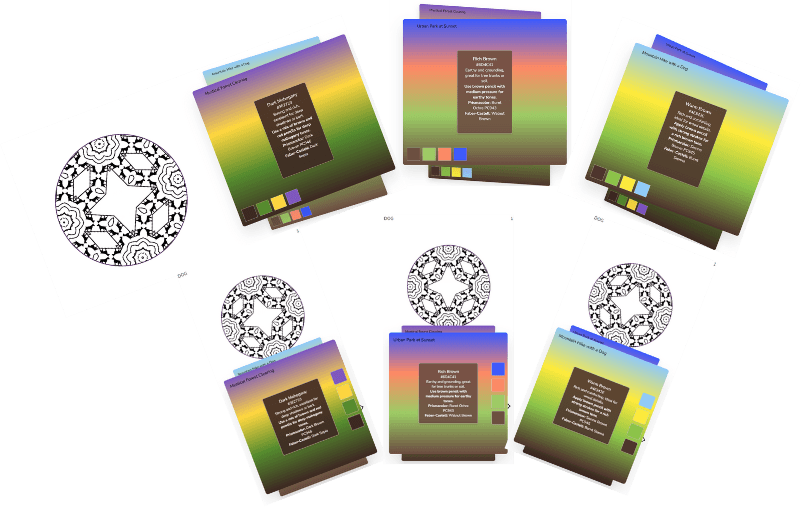
The free 4-week AnimalMandala experience shows how the same design can change when different seasonal palettes are applied.
Use the center as a reference point
A mandala does not have to be colored from the center outward.
But the center gives you an easy visual reference.
You can begin there and move through the design layer by layer.
- The center establishes the first color relationship
- The next ring introduces repetition
- Outer sections can continue or break the pattern
- The perimeter brings the whole composition together
Starting from the center can make the structure easier to read because each new decision grows from something already established.

See how those relationships work in the power of symmetry in mandala design.
Let repetition carry color across the page
Once one section is colored, look for the same or a similar shape elsewhere.
Repeat the color and the relationship becomes visible.
Change the color and a variation appears.
Alternate two colors and a new rhythm develops.
This is one of the simplest ways to build a palette without planning every detail in advance.
One choice becomes part of the composition when it begins to repeat.
Use color to separate layers
Many mandalas contain several visual layers.
The center may use one group of colors.
A middle ring may introduce another.
The outer area can repeat earlier colors or move in a new direction.
This makes it possible to use color almost like architecture.
- one palette for the center
- another for surrounding sections
- repeated accents that connect the layers
- a final color that frames or finishes the composition
Color can reveal how the mandala is built.
You do not have to preserve perfect symmetry
A symmetrical outline does not require identical coloring in every repeated section.
You can follow the symmetry exactly.
You can mirror only some colors.
You can alternate them.
You can deliberately break a repeated sequence.
The structure remains visible underneath those choices.
Symmetry gives you a framework, not a rulebook.
Let the page change as you work
A palette that looked right at the beginning may need another color later.
A repeated section may look better with more contrast.
An outer ring may suggest a color you did not expect to use.
That is part of the process.
The finished design does not need to match the first idea exactly.
The page can teach you what it needs as it develops.
Return to the same mandala with a different palette
One of the most useful ways to understand color is to reuse the same structure.
Keep the mandala identical and change only the palette.
A cool version may emphasize different sections from a warm version.
A limited palette may make the symmetry more obvious.
A wider palette may separate more individual areas.
The design becomes a stable framework for comparing different color decisions.
The outlines stay the same. The visual world changes.
Animal mandalas add the natural world to the palette
An animal gives another starting point for color.
A fox may suggest forest tones.
A dolphin may lead toward ocean colors.
A butterfly may suggest flowers, sky, and seasonal changes.
In AnimalMandala, the animal itself also participates in the symmetry.
Its silhouette repeats around the center while the surrounding space gives color room to expand.

Explore the structure in What are animal mandalas?.
Make coloring something easy to return to
A creative routine does not need to be long or complicated.
You can leave a mandala unfinished and return later.
You can color one repeated section at a time.
You can save palettes you want to reuse.
You can color the same design several times and compare the results.
What matters is making the process simple enough that beginning again feels easy.
A simple mandala coloring sequence
- Look at the complete structure before choosing colors
- Choose a small starting palette
- Find the center and one repeated form
- Repeat your first colors across related sections
- Add contrast only when the page seems to need it
- Let later choices respond to what is already there
There is no single correct way to color a mandala.
The structure gives you somewhere to begin. The color choices make the page your own.