
Mandalas are centered visual forms built through circles, geometry, repetition, and symbolic arrangement.
Across different traditions, the word and the forms associated with it have carried meanings connected with cosmology, ritual, contemplation, order, and the relationship between a center and the world around it.
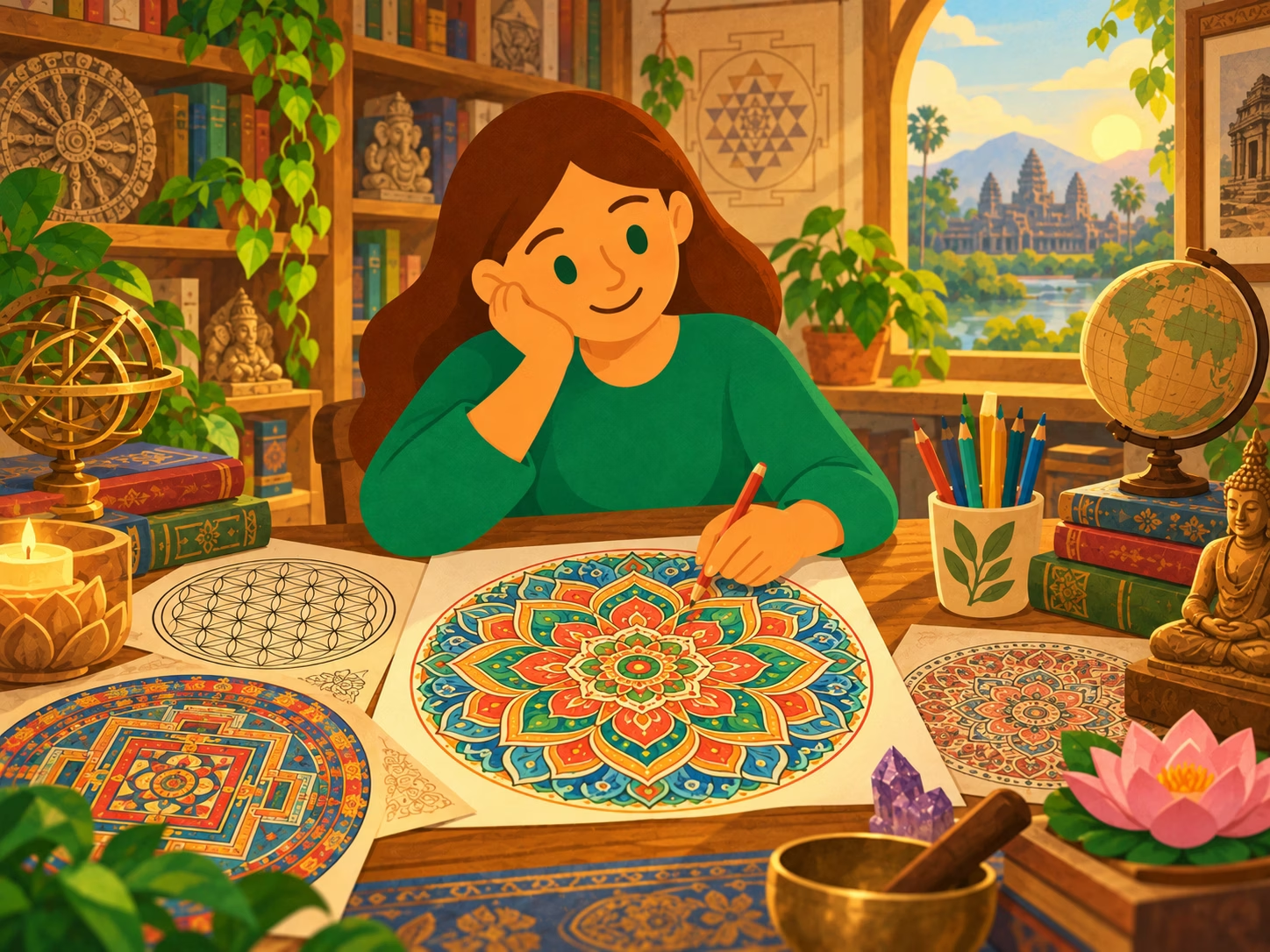
What does mandala mean?
The word mandala comes from Sanskrit and is commonly translated as “circle.”
That translation is useful, but a mandala is more than any circular pattern.
In the traditions where mandalas developed, the form can organize symbols, deities, directions, spaces, or ideas around a meaningful center.
The circle is therefore both a visual structure and, in many contexts, part of a larger symbolic system.

For the broader visual definition, continue with What are mandalas?.
The center is one of the most important ideas
A mandala usually organizes its visual world around a center.
From there, forms can expand outward through circles, squares, petals, gates, lines, figures, or repeated geometric elements.
The meaning of that center changes according to the tradition and the specific mandala.
It may mark a sacred presence, a cosmic order, a point of orientation, or simply the structural origin of the composition.
What remains visually powerful is the relationship between center and surrounding structure.
Mandalas in Hindu and Buddhist traditions
The strongest historical use of the term mandala comes from South Asian religious traditions.
In Hindu contexts, mandalas and related geometric diagrams can be used in ritual, temple planning, visualization, and representations of sacred or cosmic order.
In Buddhist traditions, especially Tibetan Buddhism, mandalas can represent highly structured sacred environments populated by symbolic figures and spatial relationships.
Some Tibetan mandalas are created from colored sand and later dismantled as part of the ritual process.

These traditions deserve their own context, which we explore in mandalas in Hinduism and Buddhism.
Not every circular symbol is a mandala
Circular forms appear in many cultures.
They can represent cycles, directions, celestial movement, community, continuity, protection, or many other ideas.
But visual similarity does not automatically make all circular symbols mandalas.
A medicine wheel, a rose window, a Celtic knot, an Islamic geometric pattern, and a Buddhist mandala come from different histories and systems of meaning.
Comparing their visual structures can be interesting, but their cultural identities should remain distinct.

The wider historical picture is explored in the history of mandalas across civilizations.
What mandalas can symbolize
There is no single universal symbolic dictionary for mandalas.
Meaning depends on the tradition, the symbols used, the purpose of the design, and the person interpreting it.
Depending on context, a mandala may be associated with ideas such as:
- Center and orientation
- Cosmic or sacred order
- Cycles and continuity
- Relationship between parts and whole
- Ritual space
- Contemplation
- Impermanence
These meanings should be read as contextual possibilities, not universal rules.
Why symmetry matters visually
Symmetry gives many mandalas their recognizable sense of structure.
A form appears, repeats, mirrors, or rotates around the center.
That repetition makes relationships between the different parts of the design easy to see.
Geometry can then become part of the meaning as well as part of the composition.

We explore this visual language separately in the power of symmetry in mandala designs.
Carl Jung and the modern psychological interpretation of mandalas
Mandalas also entered modern Western psychology through the work of Carl Jung.
Jung created and studied circular images and interpreted mandala-like forms within his own psychological framework.
He associated them with ideas such as psychic order, integration, and the self.
These are Jungian interpretations, not universal meanings of mandalas and not evidence that mandalas produce a particular psychological effect.
Their importance lies in how influential Jung became in the modern Western interpretation of mandala imagery.
What about the idea of “healing mandalas”?
The language of “healing mandalas” appears frequently in modern books, art, wellness culture, and online searches.
In religious or symbolic contexts, ideas connected with healing can have spiritual, ritual, communal, or metaphorical meanings.
In everyday creative language, people may also use the word “healing” to describe a personally meaningful experience.
That language should not be confused with a medical claim.
A mandala coloring page does not need to cure, treat, or change anything in order to be valuable as art, symbolism, or creative practice.

We explore that distinction further in mandala art therapy, separating creative coloring from professional art therapy.
From sacred form to modern visual culture
Today the word mandala appears far beyond its original religious contexts.
We see mandala-inspired forms in illustration, decorative art, tattoos, digital design, coloring pages, fashion, and contemporary craft.
Some modern designs preserve strong radial symmetry.
Others use the word more loosely for any detailed circular pattern.
This expansion has made mandalas visually familiar around the world, while also making historical context more important.
Where animal mandalas enter the story
Animal mandalas are a modern creative interpretation of circular and symmetrical design.
In the AnimalMandala approach, the animal is not simply placed inside a decorative circle.
Its silhouette can repeat, rotate, mirror, and balance around a center until the animal becomes part of the circular structure itself.

This modern interpretation is explored in What are animal mandalas?.
Meaning can also come from the person coloring
Historical symbolism is only one way to encounter a mandala.
A modern coloring page can also become meaningful through personal choices.
A certain animal may remind us of a place.
A palette may come from a season, a landscape, or a memory.
One person may care about the symbolism. Another may simply enjoy the geometry.
The history belongs to the tradition. The personal interpretation belongs to the person creating the page.
A simple way to explore mandala meaning
- Look at where the design begins
- Notice what surrounds the center
- Identify repeated symbols and shapes
- Consider the cultural context before assigning meaning
- Separate historical symbolism from your own personal interpretation
A mandala can be geometric, symbolic, sacred, decorative, personal, or several of these things at once.
Its meaning becomes clearer when we ask not only what the form looks like, but also where it comes from and how it is being used.